The True Cost of Recycling Contamination on College Campuses
Contaminated recycling costs universities hundreds of thousands of dollars annually in disposal fees, lost revenue, and operational overhead. This analysis breaks down the true cost and ROI of prevention solutions.
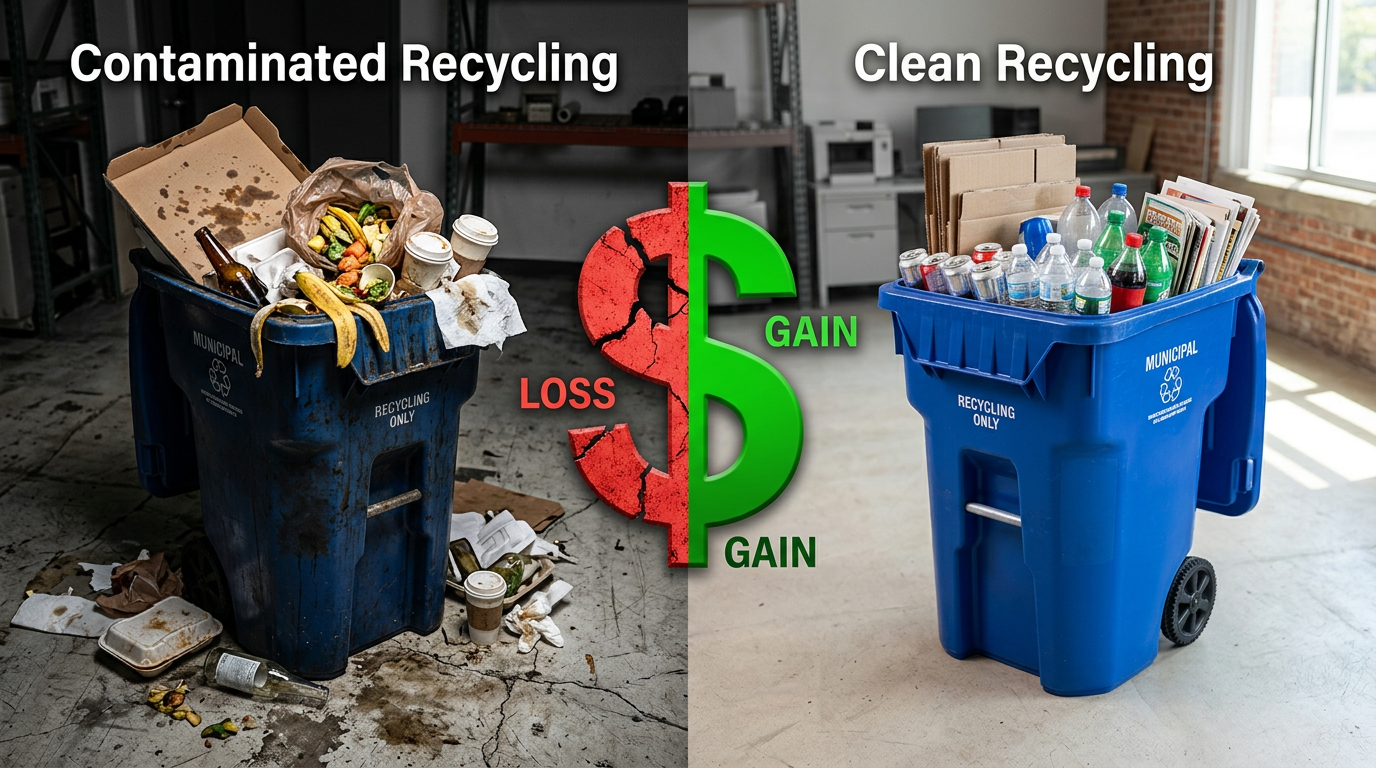
When sustainability directors talk about recycling contamination, the conversation usually focuses on environmental impact. But there's another angle that gets less attention: the financial cost.
Contaminated recycling is expensive—and not just in obvious ways. From direct disposal fees to hidden operational costs, the price tag adds up quickly. For institutions already facing tight budgets, understanding these costs is the first step toward addressing them.
This article breaks down the true cost of recycling contamination and makes the case for investing in solutions that prevent it.
Direct Costs: The Obvious Expenses
Disposal and Processing Fees
When a recycling load is deemed too contaminated, it doesn't get a second chance. Materials recovery facilities (MRFs) send it straight to the landfill—and charge for the privilege.
**Typical costs:** - Clean recyclables: May generate $30-50/ton in revenue - Moderately contaminated: No revenue, but no extra fee - Heavily contaminated (>25%): $75-150/ton in disposal fees
For a university generating 3,000 tons of recyclables annually with a 25% contamination rate, that's potentially $100,000+ in avoidable costs.
Lost Revenue Opportunities
Clean recyclables have value. Cardboard sells for $100-150/ton. Aluminum cans fetch $1,000+/ton. But contaminated materials are worthless—or worse, cost money to dispose.
A campus that could generate $50,000 annually in recycling revenue instead pays $50,000 in disposal fees. That's a $100,000 swing.
Indirect Costs: The Hidden Expenses
Labor for Sorting and Re-handling
When contamination is suspected, facilities teams may: - Manually spot-check bins before collection - Re-sort materials at central collection points - Respond to MRF quality complaints - Conduct waste audits to identify contamination sources
Estimate: 2-4 hours per week per building cluster at $25-40/hour fully loaded. For a campus with 20 building clusters, that's $50,000-160,000 annually.
Administrative Overhead
Sustainability staff spend time: - Planning education campaigns - Creating signage and materials - Training student workers - Reporting on recycling metrics - Managing relationships with waste haulers
If contamination issues consume 20% of a sustainability coordinator's time ($60,000 salary + benefits), that's $15,000 in indirect costs.
Equipment and Infrastructure
Contamination accelerates wear on: - Collection bins (food residue, liquids) - Compactors and balers (plastic bags, tanglers) - Transport vehicles (leaking containers)
Maintenance and replacement costs increase 10-20% when contamination is high.
Reputational Risk
Universities market their sustainability commitments to: - Prospective students (65% say sustainability influences college choice) - Parents and alumni (donor preferences) - Corporate partners (ESG alignment) - Ranking organizations (Princeton Review Green Colleges)
When recycling programs underperform, it undermines institutional credibility and marketing messaging. The cost? Hard to quantify, but potentially significant.
Case Study: The Contamination Cost Calculator
Let's model a mid-sized university:
**Baseline:** - Total waste: 5,000 tons/year - Recycling rate target: 30% (1,500 tons) - Current contamination rate: 25%
**Direct Costs:** - 375 tons of contaminated recyclables - At $100/ton disposal: $37,500 - Lost revenue on clean recyclables: $50,000 (revenue that should have been earned) - **Subtotal: $87,500**
**Indirect Costs:** - Labor for sorting/re-handling: $75,000 - Administrative overhead: $15,000 - Equipment maintenance: $10,000 - **Subtotal: $100,000**
**Total Annual Cost of Contamination: $187,500**
That's nearly $200,000 that could fund scholarships, facilities improvements, or sustainability innovations.
The ROI of Contamination Prevention
What if this university invested in contamination prevention? Technologies like AI verification and gamified rewards cost money—but the payback can be dramatic.
**Conservative scenario:** - Investment: $50,000/year (equipment + platform fees) - Contamination reduction: 25% → 5% - Disposal savings: $30,000 - Revenue increase: $40,000 - Labor savings: $50,000 - **Net savings: $70,000/year**
**Payback period: Less than 1 year**
**Aggressive scenario:** - Investment: $75,000/year - Contamination reduction: 25% → 0% - Disposal savings: $37,500 - Revenue increase: $50,000 - Labor savings: $75,000 - Reputational value: $25,000 (estimated) - **Net savings: $112,500/year**
**Payback period: 8 months**
Beyond ROI: Strategic Benefits
Financial returns are compelling, but they're not the only reason to invest in contamination prevention:
**ESG Reporting:** Improved diversion rates support sustainability commitments and attract ESG-focused investors and partners.
**Student Engagement:** Gamified recycling programs enhance student life and demonstrate institutional innovation.
**Operational Efficiency:** Cleaner recycling streams simplify facilities management and reduce friction with waste haulers.
**Leadership Position:** Early adopters of recycling technology position themselves as sustainability leaders in higher education.
Making the Case
If you're a sustainability director or facilities manager advocating for investment, here's how to frame the conversation:
1. **Quantify current costs** using the framework above 2. **Present the ROI** of prevention solutions 3. **Highlight strategic benefits** beyond financial returns 4. **Propose a pilot** to demonstrate results before full rollout 5. **Track metrics** and report success to build momentum
Contamination isn't a problem you can educate your way out of. It requires systems that work at the point of disposal—where students make decisions in seconds, not after reading detailed guidelines.
The true cost of contamination is the opportunity cost of not solving the problem. Every year you wait is another year of wasted money, missed goals, and preventable environmental impact.
*Next: [Why 25% of Campus Recycling Ends Up in Landfills](/)